Monday, September 12, 2022
Mother Treesa
This is a very special tree. She lives inside the Great Circle Mound (Newark, Ohio), which was constructed approximately 2000 years ago, by the Ohio Mound builders. This painting is oil on wood panel, and is 11x14 inches.
Tuesday, August 30, 2022
Artist William Whitaker had told me about an oil painting medium called Maroger. He swore by it, and indicated that it was his favorite medium. This medium had been controversial, for many reasons, and yet he emphatically stated to me that it was ok. So, I purchased the ingredients, and made a batch. The medium consists of equal parts of double mastic varnish, and black oil (lead oxide cooked into linseed oil). I made the varnish, and purchased the black oil from Kremer. In combining these products, a soft thixotropic gel forms, and is truly one of the finest painting mediums ever known. I used the medium in the paint for this painting, which was quite literally a practice piece, for using this medium. I also enjoyed painting this.
The Effect of Adding Amber Varnish To Oil Paint
There truly is something mystical about adding Baltic amber varnish to oil paint. Although certainly all images are dependent on composition, contrast, color, and value, amber seems to decrease the value in the darks, and increase the translucent effects, in high value areas.
Sunday, August 28, 2022
Tuesday, November 25, 2014
Hard Copal Mediums
When it comes to oil painting mediums, one of the best, for special purpose, is copal. Traditional copal oil painting mediums were made from several hard copals found in Africa, and thus were unknown in European painting, prior to the time that Africa was colonized. Many of the former resources have dried up (having been used extensively in a variety of products), and or the areas were these materials were found, have presently become far to politically unstable to visit.
One of the very best copal mediums formerly available, was made by Frederick Taubes, and sold through Permanent Pigments out of Cincinnati, Ohio. That company later became Liquitex, and subsequently discontinued oil painting materials. Taubes used a very hard copal, which came from the Congo region of Africa, and produced a very light varnish. Again, these products are no longer easy to find, and thus difficult to hold as a general material, in the tool box.
Presently there are soft copal mediums available, but in my opinion, having made them, and having used them, I do not think that they perform the same as hard copal versions. When we say hard, vs. soft copal, does this imply that one version is actually harder than another? Well, yes it does seem to imply this. However, when we look at these materials in terms of actual hardness, using a tool such as Moh's hardness scale, we find that the hard versions of copal are no harder than the softer versions. Therefore, I don't think that "hard" or "soft" is a good descriptive measure. Rather, we should look at copals in terms of polymerization. What we consider to be hard copal, is generally polymerized to a much greater degree. These materials may be centuries, if not millennium in age. Of course, the copals are no where near the state of the several amber materials (which are tens of millions of years old), but what we commonly call hard copal is polymerized to a much greater degree, than the so called soft copals we see today. In addition, what we know as hard copal, comes from entirely different botanical sources, and regions of the earth. Copal is such a generic word, and connotes a particular type of resin. However, in reality it is akin to saying the word "vehicle." What is meant by this? Boat, car, airplane? In fact, copals are as different from one another as a boat is from a bicycle. They are of different ages, from different regions, different botanical origin, different chemical makeup, and of course, have vastly different properties from one another.
The use of mediums which contain highly polymerized copals of African origin, does permit special effects that no other medium will provide. It allows one to lay a brush stroke down, and have that stroke remain just as it was laid down, without any fusion of edges, or migration. It also creates a stringiness to paint, when used in just the right concentrations. Some people have come to use mediums which contain damar, as a substitute, and in fact, even Taubes did this, but these mediums do not create the same effect, and it is my belief that they are not as durable. Old copals of African origin will not dissolve in turpentine, but damar will. The recent copals will also often readily dissolve in some solvents. I have also observed multiple oil paint films, which contained damar as a medium, to crack in a relatively short time.
When it comes to making copal mediums, as stated earlier, some copals will readily dissolve in solvent, and can then be added to a drying oil. However, those old highly polymerized copals of African origin were not dissolved in solvent, but rather heat fused with drying oil. That process was formerly completed in industrial production facilities, but when undertaken by the individual, can be a very difficult and dangerous task. Not to be the bearer of bad news, but it is my belief that there is no product available today, which will produce the same results as the old copal mediums, from the past. Of course, this is my opinion, and as with everything else, it is a debatable subject. This is not to say that artists can not paint without copal, or that there are no good oil painting mediums. There are many. However, in my opinion, there is nothing around that will presently provide the same results. It is also my opinion, that artists should spend their time painting, and experimenting with mediums that are available, for the purposes they seek, rather than undertake the dangerous task of making highly polymerized copal, into a usable medium. Considering the cost of materials such as Congo copal, or copal from Sierra Leone, most people will destroy a great deal of material in the attempt to produce a usable medium, and there simply is not enough material presently available to support the learning curve (of most people), necessary to drive this material into a drying oil.
One of the very best copal mediums formerly available, was made by Frederick Taubes, and sold through Permanent Pigments out of Cincinnati, Ohio. That company later became Liquitex, and subsequently discontinued oil painting materials. Taubes used a very hard copal, which came from the Congo region of Africa, and produced a very light varnish. Again, these products are no longer easy to find, and thus difficult to hold as a general material, in the tool box.
Presently there are soft copal mediums available, but in my opinion, having made them, and having used them, I do not think that they perform the same as hard copal versions. When we say hard, vs. soft copal, does this imply that one version is actually harder than another? Well, yes it does seem to imply this. However, when we look at these materials in terms of actual hardness, using a tool such as Moh's hardness scale, we find that the hard versions of copal are no harder than the softer versions. Therefore, I don't think that "hard" or "soft" is a good descriptive measure. Rather, we should look at copals in terms of polymerization. What we consider to be hard copal, is generally polymerized to a much greater degree. These materials may be centuries, if not millennium in age. Of course, the copals are no where near the state of the several amber materials (which are tens of millions of years old), but what we commonly call hard copal is polymerized to a much greater degree, than the so called soft copals we see today. In addition, what we know as hard copal, comes from entirely different botanical sources, and regions of the earth. Copal is such a generic word, and connotes a particular type of resin. However, in reality it is akin to saying the word "vehicle." What is meant by this? Boat, car, airplane? In fact, copals are as different from one another as a boat is from a bicycle. They are of different ages, from different regions, different botanical origin, different chemical makeup, and of course, have vastly different properties from one another.
The use of mediums which contain highly polymerized copals of African origin, does permit special effects that no other medium will provide. It allows one to lay a brush stroke down, and have that stroke remain just as it was laid down, without any fusion of edges, or migration. It also creates a stringiness to paint, when used in just the right concentrations. Some people have come to use mediums which contain damar, as a substitute, and in fact, even Taubes did this, but these mediums do not create the same effect, and it is my belief that they are not as durable. Old copals of African origin will not dissolve in turpentine, but damar will. The recent copals will also often readily dissolve in some solvents. I have also observed multiple oil paint films, which contained damar as a medium, to crack in a relatively short time.
When it comes to making copal mediums, as stated earlier, some copals will readily dissolve in solvent, and can then be added to a drying oil. However, those old highly polymerized copals of African origin were not dissolved in solvent, but rather heat fused with drying oil. That process was formerly completed in industrial production facilities, but when undertaken by the individual, can be a very difficult and dangerous task. Not to be the bearer of bad news, but it is my belief that there is no product available today, which will produce the same results as the old copal mediums, from the past. Of course, this is my opinion, and as with everything else, it is a debatable subject. This is not to say that artists can not paint without copal, or that there are no good oil painting mediums. There are many. However, in my opinion, there is nothing around that will presently provide the same results. It is also my opinion, that artists should spend their time painting, and experimenting with mediums that are available, for the purposes they seek, rather than undertake the dangerous task of making highly polymerized copal, into a usable medium. Considering the cost of materials such as Congo copal, or copal from Sierra Leone, most people will destroy a great deal of material in the attempt to produce a usable medium, and there simply is not enough material presently available to support the learning curve (of most people), necessary to drive this material into a drying oil.
Wednesday, April 16, 2014
Why Use Baltic Amber Varnish In Oil Painting?
Amber has been used in oil painting for centuries. Although it was certainly not the predominate medium of the Renaissance, much evidence does exist to ascertain that it was used. Many artists upon hearing of old mediums such as those containing amber, will often wonder if it imparts some special property, or quality to paint. My answer to this is opinion, based on my own experience. Having made quite a bit of amber varnish from the raw materials (a process that I would not recommend) I have been able to adjust the resin to oil ratios, in many versions, and have found that at certain percentages of resin to oil (linseed), the material does create a medium that will effect oil paint in ways that no other substance, including the various copal mediums, will accomplish.
I have found that the addition of a single drop of amber medium, to a pea sized paint nut will dramatically alter the properties of the paint. If one mixes one drop into the paint nut, and then waits one hour, the paint will stiffen up, and perform more like a jewel paste, than a loose oil paint. This will permit many impasto effects, as well as multi-layered techniques, all on the same day. The strokes will tend to remain exactly as they are laid down, with no slumping, fusing, leveling or changes of any type. Some copals permit this, but in a slightly different manner, and I know of no balsams and certainly no dammar containing mediums that will perform this way. Drying oil alone will absolutely not permit these effects.
At lower resin to oil ratios, the medium will permit some effects that are very similar to the glass like, or enamel appearing effects that one may observe in the works of the Flemish masters.
Is amber the best of all oil painting additives? Quite frankly, I would say that there is no one medium that is the best. The better question is which medium is best for which special effect. In that regard, there are certain special effects that amber will permit that would be exceedingly difficult, using any other medium. Does it duplicate the effects of mediums containing larch turpentine, or Canada balsam? Absolutely not. It is important to ask what one is trying to accomplish. Many artists take up oil painting, and then go looking for a medium to help them out, without knowing what it is that they even want to accomplish, or what special effect they are after. This is a flawed, and costly method of progressing.
If oil paint alone, or with the addition of a small amount of drying oil, is all that is necessary for an artist to carry out their work, then certainly there is no need to throw amber, or any other medium into the mix. If on the other hand one is looking for effects as stated above, it may be a nice addition.
The final note that I would like to convey is that if amber varnish is used as a varnish, over the entire oil painting, a removable solvent varnish should be applied over it, at the appropriate time. Amber varnish is not removable, by any method that will not destroy the underlying paint film. So, again, a final removable varnish should be used.
Saturday, December 22, 2012
Negotiation
I started this painting last week. It is 24 by 36 inches, oil on shellac primed cradled wood panel. The paint is Winsor and Newton, artist grade, Liquitex oil paint, Williamsburg, and my own hand made titanium white, genuine ivory black, and Venetian red.
Getting close to covering the panel with the first layer. After I cover the girls left arm, I will start working to refine the painting. A huge number of details to complete.
Monday, October 29, 2012
Portrait of a Sculptor
This is an oil painting of artist Dave Thomas (Now Deceased). It is 24x24 inches, and is being completed in layers, using a variety of paints. The medium that I have used on this, consists of cold pressed linseed oil, in a palette cup, to loosen the strokes. The paint has a small addition of a medium that I made recently, consisting of Venice turpentine, stand oil, and gum spirits of turpentine. This medium is a slower drying oil, balsam, essential oil medium, and permits some effects that I was seeking. At this point, I have applied an isolating layer of very thin amber varnish. It is now dry, and ready for overpainting.
This image is significant to me, as having been cremated, Dave no longer exists. However, in my mind he does, and the day that is depicted does as well.
Monday, October 15, 2012
Sunday, July 15, 2012
Looking Forward to Autumn
This summer has been very hot and very humid. Although the warmth, and the light have been very good, I sure am looking forward to a cool dry breeze.
Waiting For The Parade
Oil on shellac primed, cradled wood panel. This painting is 24 inches by 36 inches. I have been very interested in the effects of light, and tried to focus on this, as opposed to minute details. The painting was completed in more of an impressionistic manner, and I tried to focus on color, value, and textural contrasts. In addition to oil paint, I added a small amount of medium composed of Venice turpentine, stand oil, and gum spirits of turpentine. There is still some work that needs to be completed, and then a final varnish.
Saturday, April 14, 2012
Lester Boronda
As a descendant of Manuel Boronda (1750-1826)
http://en.wikipedia.org/wiki/Rancho_Los_Laureles, I recently became aware that artist Lester Boronda 1886-1953 http://www.carmelfineart.biz/Lester-Boronda-Fandango.html is a distant cousin. I love the works that I have seen, and will be researching him more.
Thursday, April 5, 2012
After Murillo
Trying Out a Frame
Saturday, March 24, 2012
Saturday, March 10, 2012
Hard Copal for Mediums and Varnishes
This is hard copal, and is not soluble in gum spirits of turpentine. The material must be fused, in order to be cooked into a drying oil. The image above is of copal in its unproecessed state (right). On the left, and much darker in appearance is the same copal that has been fused. The one on the left is ready for further processing, in order to combine with linseed oil.
Hard copals are really no harder than soft or or recent copals, when using Moh's hardness scale. The difference is in the level of polymerization, and the resulting necessity of various methods of processing. Hard copals require a greater degree of processing, in order to make them into viable art materials. Much of what is presently available (copal mediums) are made from soft copals, and I don't think that these materials are the same as those used by artists in previous centuries. Hard copals are exceptionally difficult to process, and then even more difficult to subsequently combine with a drying oil, to form varnishes, and or mediums. Taubes method is very useful, yet without an added step, not mentioned in his book, it remains a very difficult proposition. If not completed just right, one will end up with a turbid mass, or a pot of ash.
I personally would not use any copal mediums, in my artwork that are light, and made with recent copal resins. Due to several reasons, the best varieties of hard copals are no longer available, and any of the resulting mediums and varnishes that I would buy, are no longer being produced.
Gum Elemi, used as a Medium.
This series of posts was completed for artist Graydon Parrish, to assist with his lecture on a particular painting (William Bouguereau's Nymphs and Satyr) as completed by William Bouguereau (http://grandcentralatelier.blogspot.com/2012/03/graydon-parrish-to-lecture-at-clark.html). It is a description of this material, and the reasons for its use. Nothing in these posts is an encouragement of others to make or use this medium, and is stated merely as a description of the material, and how I have made it.
It is a known fact that William Bouguereau used elemi, and copal in his work. In the world of art, and more specifically, oil painting, there have always been mediums, used for various effects. I don't wish to enter into debate with those who believe that all effects known to oil painting, can be accomplished with just drying oil alone. Although I do respect the opinions of others. I do not believe this, and in experimenting with many different mediums, have found that some provide effects that oil alone will not accomplish. Amber, copal, and many others.
Gum elemi has been of interest to me, for quite a few years. Years ago, at the Toledo Museum of Art, I had the opportunity to study a painting by William Bouguereau. I noticed that the surface of the paint film was absolutely smooth. No raised spots or even brush strokes visible. The image was of a girl, and all of the edges were fused. The image created an effect of being more real, than a photo. Based my observation, I became convinced that something more than oil paint alone was used to create the work. A bit of research led to an understanding that copal and elemi was used by that artist, as a medium. This led to experimentation with elemi, and although I have never come close to creating a work, such as that artist, I have noticed that the mediums which contain copal and elemi permit some comparable effects.
Gum elemi derives from trees in the Phillipines, Southeast Asia, and other locations in the tropics. It is a balsam, although cloudy in appearance, and not at all like the other balsams, upon initial consideration.
It was used in the past as a plasticizer for varnishes, as it was known to remain flexible, and this can be beneficial, to prevent cracking to crystalline varnishes applied over an oil film.
Used as a medium, elemi would be of no use by itself, as it is initially too viscous, and would not impart any benefit to oil paint, in its raw state. Once processed however, I have found that this material imparts some quite impressive effects. In using it as a medium, the plasticizer effect is helpful, but there is an additional effect of permitting paint to tack up while remaining wet, and I don't think that anything provides a better blending effect. Although Canada balsam, and Venice turpentine permit paint to blend quite well, gum elemi surpasses them, in my opinion.
Bouguereau used various mediums in creating his work, and it is known that he combined gum elemi, with hard copal medium. This medium is quite impressive, in that it permits all of the effects of copal, while allowing for a better blending effect, is thinner initially, and again, acts as a plasticizer.
The picture above is gum elemi in its unprocessed form. It is very viscous, and yet will flow very very slowly over time.
Gum Elemi used as a Medium 2
Unprocessed gum elemi. Very viscous, and will hold a palette knife that is stuck into it.
This is a photo of a jar of gum elemi, mixed with gum spirits of turpentine, and one can observe the clear material at the top, and the sediment that forms on the bottom.
This is the gum elemi mixed with gum spitits of turpentine. It is starting to get cloudy as the elemi dissolves in the solvent.
A little while later, and a little more cloudy. This will dissolve down to its saturation point. That is where no more resin can be accepted by the solvent, and then the remainder will stay in an undissolved form. I like to go by the saturation point as a reference point.
The resin is a component of the entire material. I dissolve the raw material in gum spirits of turpentine, thus liberating the resin from the waxy material and debris, which remains at the bottom of the jar. The resin in the turp is clear as water. At that point, I add a little more raw elemi, and watch it over a day. It will continue to dissolve, and when no more of the lump goes down, it is at a saturation point. I wait till fully settled, and clear, then remove carefully, with eye dropper. I then combine 50/50 with hard copal medium. Very little will alter the properties of paint.
This material will remain cloudy for several days, and then will clear. The turpentine will solve the resin, and a waxy sediment will form, on the bottom of the jar. The debris will remain with the sediment. This sediment can still retain some unsolved resin, and I won't go into detail about my exact process, but the material that is on top is absolutely clear, and to my eye refracts light to a greater extent than water, as it magnifies images through the glass, moreso than other materials. I would further add that the material is as liquid as gum spirits of turpentine.
I remove this material very carefully with an eye dropper, to avoid stirring up the sediment.
This is a picture of the elemi that has been removed from the jar. It is very clear, and thin, in its nature.
Another picture of the elemi. I store this material in 30 ml. bottles, and have found these quite useful.
In this state, the material can faciliate the manufacture of copal mediums, as it acts as a thinner, yet jacks up the resin content, all the while, acting as a plasticizer, and permitting effects that copal alone does not. It also seems to speed up the drying of oil paint.
Although very thin, once the turpentine evaporates off, a highly sticky residue remains. This residue provides the benefit to paint, in my opinion.
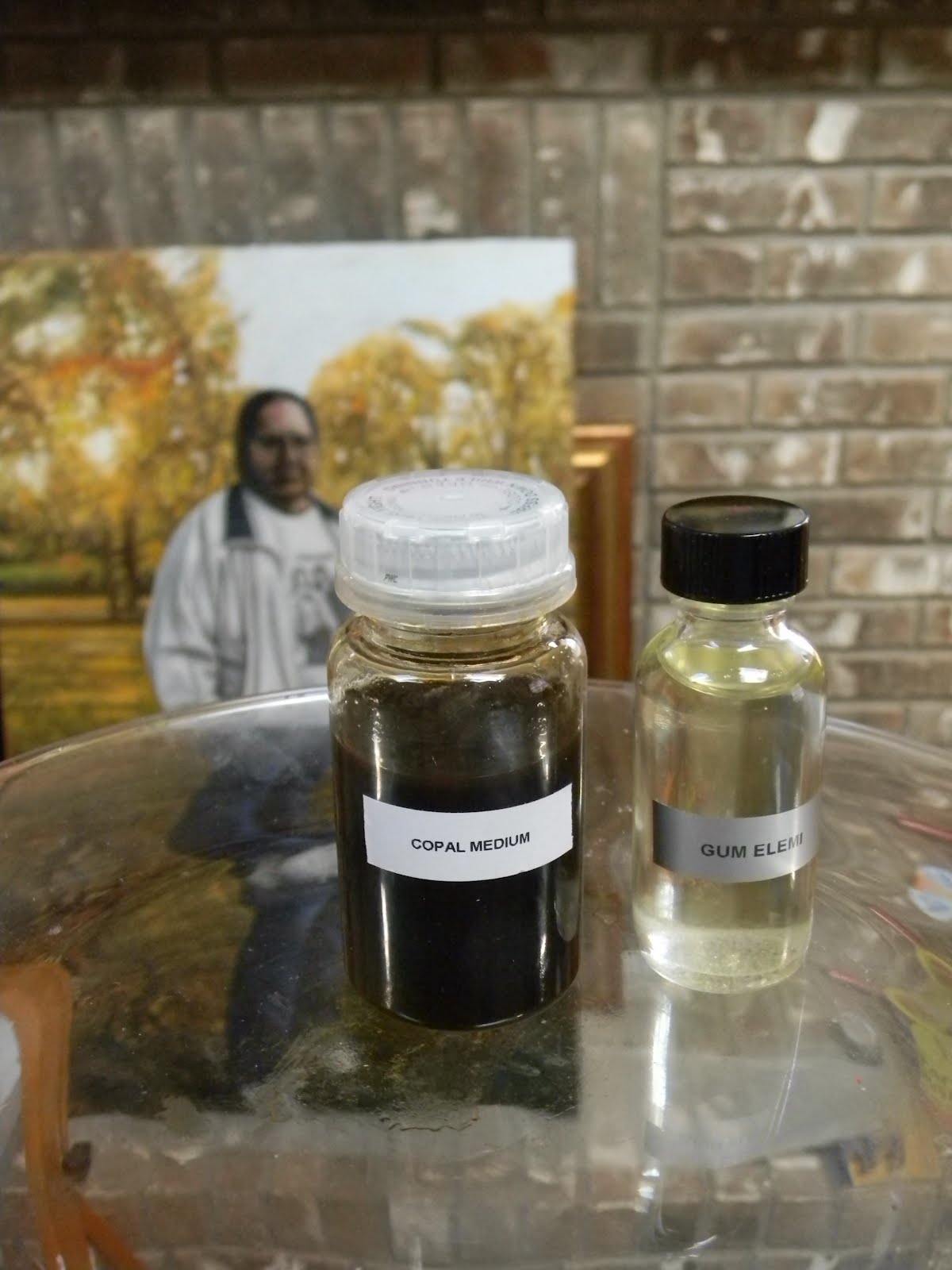
This is a small jar of copal medium that I made last year. It is hard copal that has been fused, processed further, and then cooked into linseed oil. This is an excellent medium, for a variety of uses.
These are the two materials that I will combine, to create a copal/elemi medium. The copal has a resin content of approximately 25% resin to linseed oil.
The copal is from Kremer, and is a hard copal. This doesn't mean that on Moh's scale it is any harder than a soft resin, such as damar, or manila copal. Rather, it must be fused before it can be made into a medium. Fusing hard resins is difficult, and dangerous, and I would not encourage anyone to try it. The copal is actually quite a bit more difficult than even amber to fuse, and make into a medium, as it is very difficult to effectively combine with linseed oil. Amber is much easier. If not done right, one ends up with an unusable mass that resembles snot. A turbid disaster. There are also serious dangers regarding the heat needed to process this material.
In this picture, I have a small amout of copal medium, on a palette knife. I will place this on the glass plate.
Subscribe to:
Posts (Atom)
.jpg)